Why I Love New Wave Sci-Fi
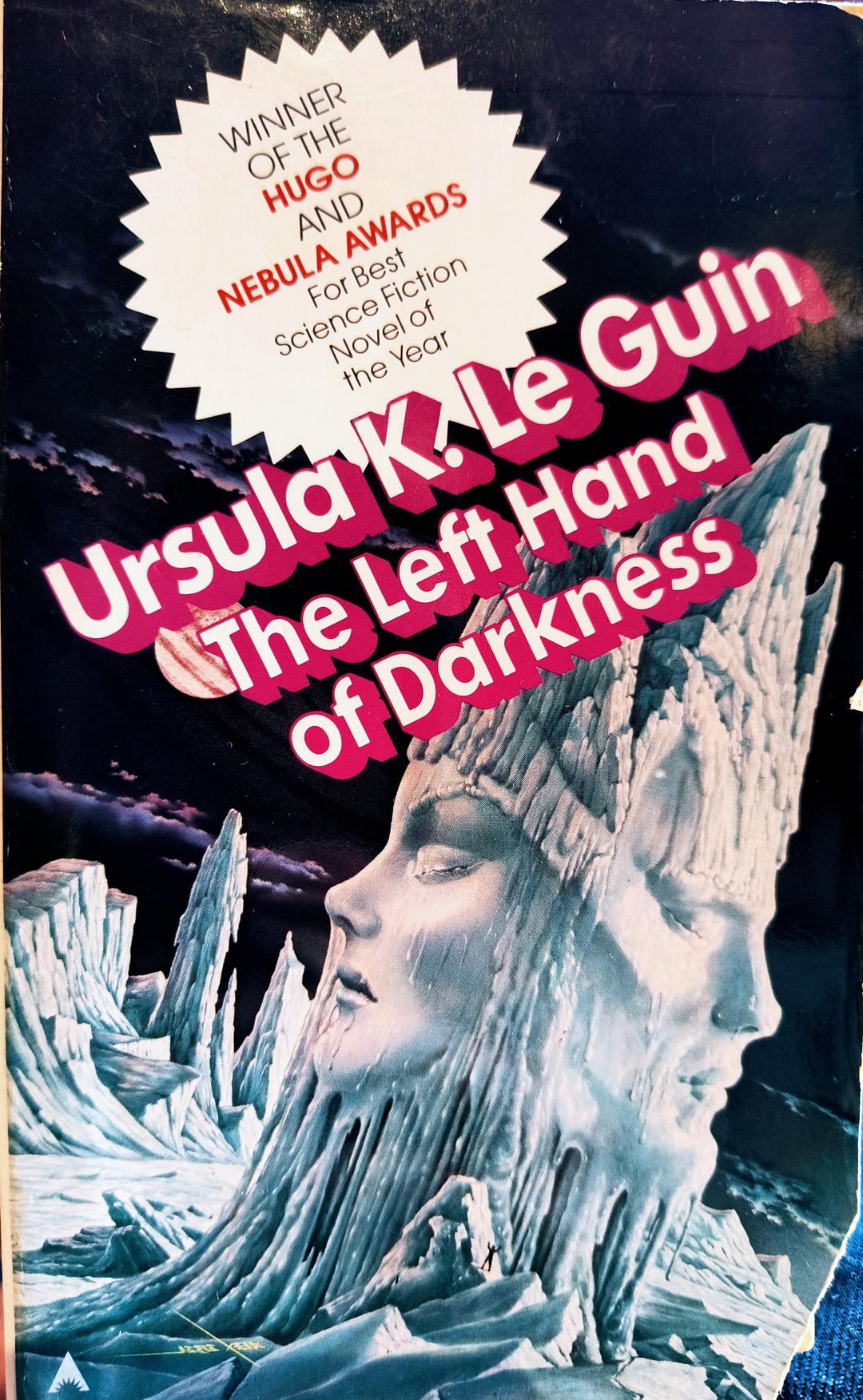
So basically anyone who knows me knows that I love sci-fi. But what originally drew me into the genre as a kid was the novels and stories that came out of the New Wave period of sci-fi.
The New Wave period was a period of time from the '60s to the '70s where due to a lot of factors, there was a large shift in what was being produced by sci-fi authors. People were trying to separate sci-fi from the associations of pulp fiction and escapism fantasies that it gained during the Golden Age of Sci-Fi, and as a result there was a lot more experimentation with the medium than there had been before. Authors were utilizing the medium to critique societal and political norms; this was done especially in places in which outright criticism of the government was very risky, such as the USSR.
Popular authors of this time include Ursula k. Le Guin (my favorite), Samuel r. Delany (btw he annotated a bunch of the copies of his books at the Schomburg Center for Research in Black Culture in Harlem if you're curious it's cool), Stanisław Lem, James Tiptree Jr. (pseudonym of Alice Sheldon), Philip k. Dick, and Arkady and Boris Strugatsky (strugatsky brothers, authors of the novel that inspired the S.T.A.L.K.E.R. series). This is by no means an exhaustive list though, a lot of amazing authors contributed to this movement.
Anyways, what makes a lot of the stories this movement produced so great is that there was a lot of exploration of sciences outside of the hard science that was expected from sci-fi before this movement. Authors used ideas from psychology, sociology, ecology, and political science. A lot of novels from the New Wave movement also explored gender and sexuality through feminist and queer lenses, though it depends on the author because some male New Wave authors were still pretty sexist. Regardless, sci-fi became a vehicle in which authors could critique society, and envision a better one.
My personal favorite novel (both from this movement and just in general) is The Left Hand of Darkness by Ursula k. Le Guin (cover pictured above). The novel is part of Le Guin's Hainish Cycle, a series of books that for the most part follows reconnecting planets of human colonies after a very long dark age. It's also not chronological and none of the characters from each book show up in other books in the series, so you can technically read it in any order, although there are reading orders people make. If you're looking to get into it though The Left Hand of Darkness is a great place to start. The Left Hand of Darkness follows Genly Ai, a man from the planet Terra who is sent down as an Envoy by the Ekumen (they're like Space UN except they're actually pretty chill) to Gethen (also known as Winter), an ice planet whose inhabitants are biologically nonbinary, and as a result have no gender roles.
I'm really trying not to spoil anything but this novel is not just an excellent examination of gender roles, but it also has a really incredible critique of nationalism and capitalism. It also has a really great relationship in it (and this is coming from someone who hates unnecessary relationships in novels), as well as only one main character that has a binary gender. In 1969! It also has an incredibly fleshed out alien culture (this goes for like every single one of Le Guin's works though) complete with a conlang!
To acknowledge some of this books faults, first of all, it has those, as sad as I am to admit it because I love it. Le Guin uses he/him pronouns for all of the Genthenians because she thought using they/them when every single character except the main one was nonbinary would be confusing (because it lowkey would). She stated later in an essay that she regrets this choice because it makes the reader subconsciously consider the Genthenians male which takes away from the themes of the novel. She also attempted to make up for it by using she/her pronouns for all the Genthenians in a short story she wrote set on Genthen, although you can also make an argument about that too. Someone lowkey should've told her about neopronouns. A lot of people also say that she didn't take the feminist themes far enough, and like to her credit the novel was published in 1969, when women still couldn't have their own credit cards in the US, so like she was doing a lot for the time by writing about nonbinary people before they had a term for it. Anyways Ursula k. Le Guin actually had a really good track record for growing from and moving on from a lot of her less good takes; she rewrote an entire book of essays to update her less good takes since like she grew as a person and that's awesome! I mean she was born in 1929 so she was like pretty damn woke for the time. She died in 2018 so sadly I will never get to meet her and tell her about neopronouns.
Anyways The Left Hand of Darkness is peak and you should read it and also her other books; I recommend A Wizard of Earthsea which is a book about wizard school before JK Rowling (fuck you JK Rowling, you were not the first woman to write about wizard school no matter what you say). It's also like significantly better to the point where you can read it as an adult and it really holds up. It also has a really diverse cast of characters unlike Harry Potter, especially for 1968. It also has a lot of boats and I love boats and you should love boats too. Good stuff. Also please go to your local bookstore to buy it and don't use amazon; if you're going to read it online just pirate it (there's like a million links just look up a pdf), I don't think Ursula k. Le Guin would've cared, she did not believe in capitalism.
To conclude, I want to share one of Ursula k. Le Guin's most famous quotes but a good one nonetheless: